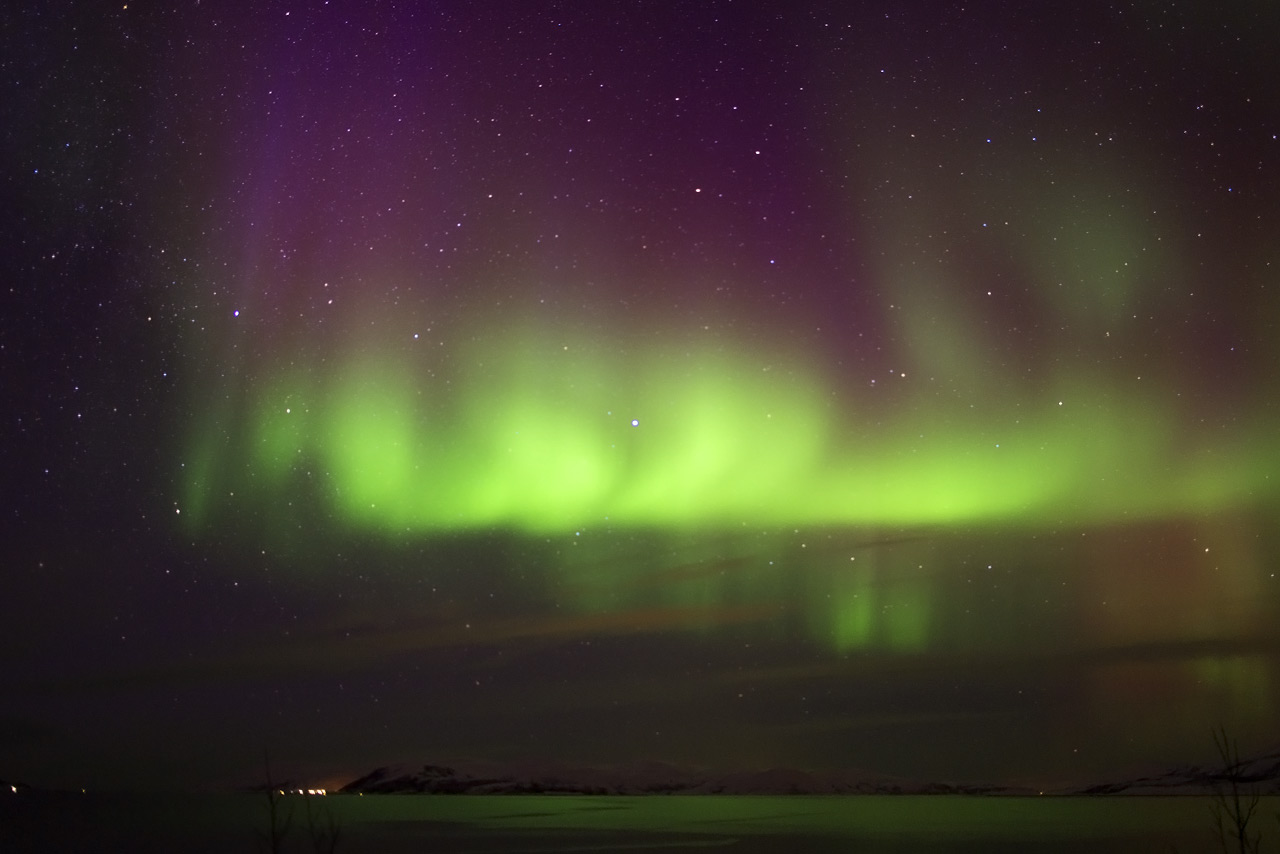
Seeing the Northern Lights in person is one of those rare experiences that sits permanently near the top of the bucket list, right alongside the quiet fear that Mother Nature might refuse to cooperate when you finally get there. Unlike a monument or a racetrack, you can’t simply buy a ticket and expect the Aurora Borealis to show up on schedule. You need charged particles hurled from the sun to collide with the Earth’s upper atmosphere, darkness free from light pollution, and—hardest of all in the middle of an Arctic winter—a clear, cloudless sky.
“You can’t simply buy a ticket and expect the Aurora Borealis to show up on schedule.”
While planning our 70-day European adventure in early 2013, Meaghan and I knew that if we were going to travel to the other side of the world while Europe was still locked in winter, we had to head far enough north to give ourselves a fighting chance. Coming from Australia, where a “freezing” winter’s night in Melbourne barely dips near zero, the prospect of standing motionless on a frozen lake well above the Arctic Circle at minus-fifteen degrees was equal parts thrilling and intimidating.
Into the Arctic Night
“Every breath turned immediately to ice on our scarves, and camera batteries drained in minutes.”
By day, the landscape felt like another planet altogether: endless expanses of snow-draped peaks, frozen fjords, and a low winter sun that seemed to spend hours hovering in a perpetual golden twilight. By night, our routine revolved entirely around two things: refreshing cloud-cover maps and checking the planetary Kp-index for signs of geomagnetic activity.
Bundled in every thermal layer we owned—merino base layers, fleece, down jackets, thick mittens over liner gloves, and boots rated for deep snow—we left the glow of town behind and headed out toward the open expanse of the frozen water. Out in the dark, the silence is almost physical. Without wind or traffic, the only sound is the dry crunch of compressed snow underfoot and the occasional click of a tripod leg locking into place.
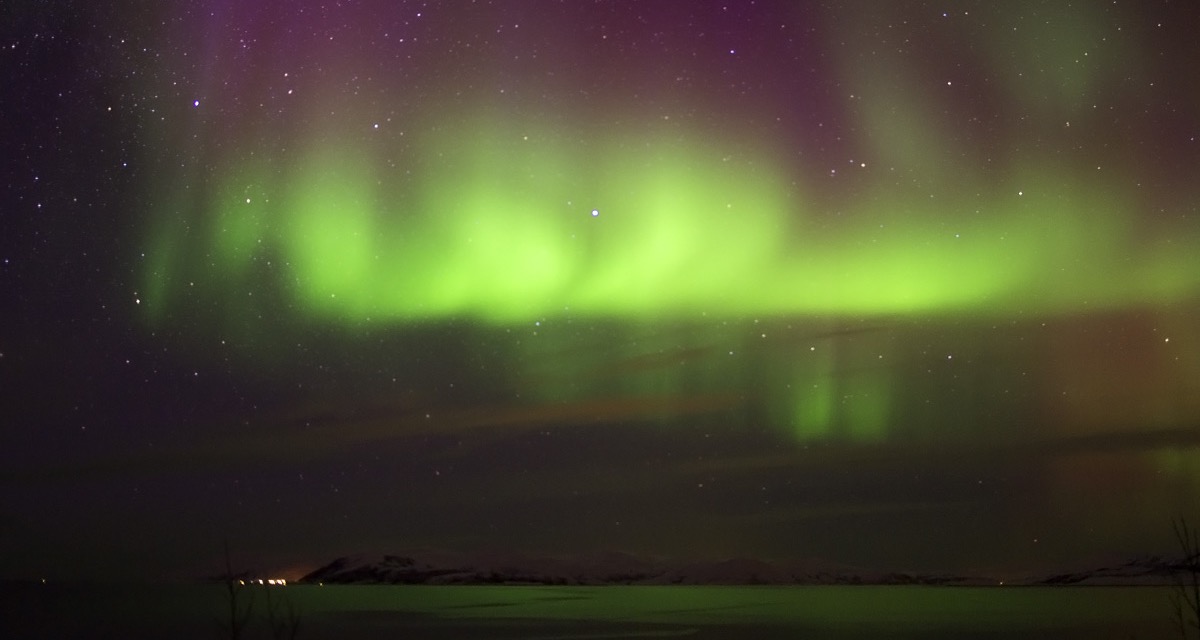
Green and violet ribbons stretching low across the frozen horizon.
The Ghostly Arc
At first, your eyes play tricks on you. Staring up into a star-filled sky for an hour in sub-zero temperatures makes every faint wisp of high-altitude cloud look suspiciously like an aurora. When the first ribbon finally appeared low on the northern horizon, it didn’t look like the neon green postcards at all—to the naked eye, a faint aurora looks like a pale, chalky brushstroke of silver-grey mist drifting slowly across the stars.
The giveaway is the camera sensor. Taking a quick ten-second test exposure revealed what our night-adjusted eyes couldn’t quite resolve yet: an unmistakable band of electric lime green glowing above the dark silhouette of the mountains. Within minutes, that faint arc began to brighten and sharpen, no longer needing a long exposure to betray its colour.
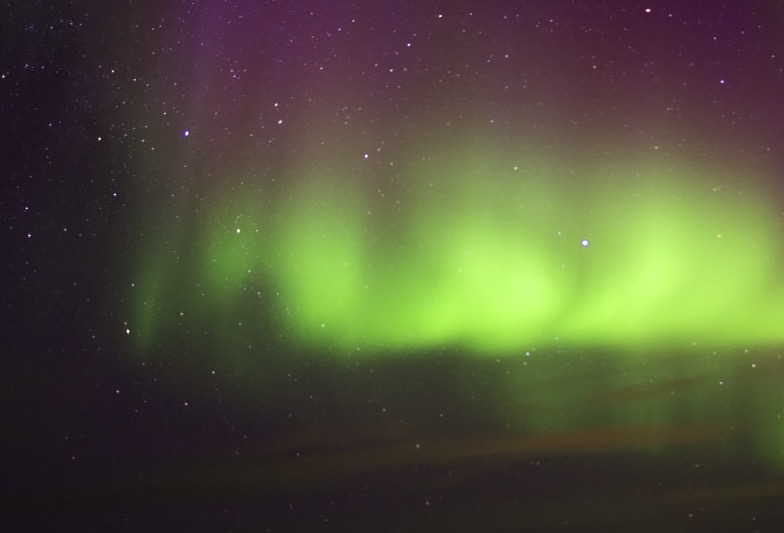
Vertical pillars of light reaching high into the night sky.
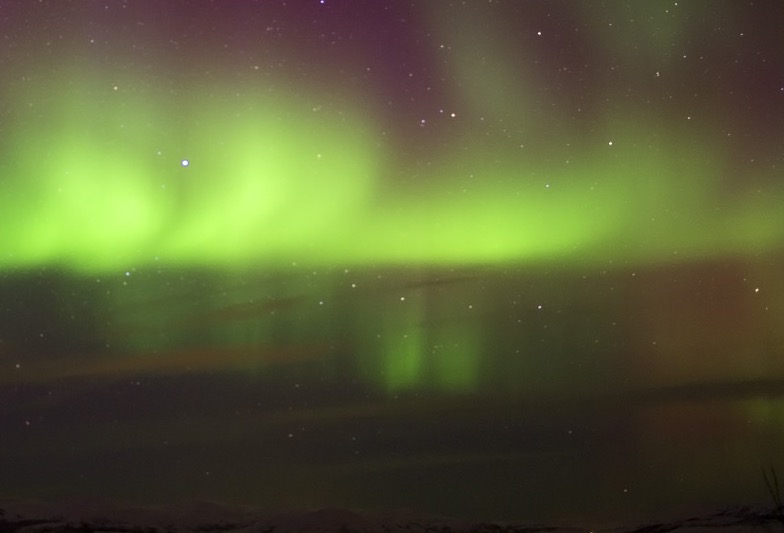
The lower emerald edge reflecting softly across the frozen lake below.
When the Sky Starts Dancing
“It looked as though someone had drawn a giant brush dipped in emerald and violet across the stars.”
Nothing truly prepares you for the moment an aurora transitions from a static glow into an active substorm. Across the span of a few breaths, the band stretched from horizon to horizon and began to fold in on itself like a heavy velvet curtain caught in a breeze. Vertical rays—tracing the invisible lines of Earth’s magnetic field—rippled rapidly from west to east.
As the solar activity intensified, the lower edge of the curtain burned a vivid emerald green (caused by solar particles colliding with oxygen atoms roughly 100 kilometres up), while the upper reaches flared into a rare, deep magenta and violet—the signature of excited nitrogen molecules even higher in the atmosphere. Down on the ground, the snow and ice began to catch a faint, otherworldly green reflection.
For a few unforgettable minutes, we completely forgot how cold our fingers and toes were. Everyone fell quiet, save for the occasional involuntary gasp and the quiet mechanical clack of camera shutters closing in the dark.
Shooting in the Deep Freeze
Photographing the Northern Lights is a crash course in operating a camera entirely by muscle memory. When your fingers go numb inside thirty seconds of taking off your outer gloves, tiny dials and menu screens become your worst enemy. A few lessons learned the hard way out on the ice:
Field Notes & Camera Setup
- Focus before you head out—or use a bright star. Autofocus is useless in the pitch black. Switch the lens to manual focus, use Live View at 10× magnification on a bright star or distant shoreline light, and tape the focus ring down so you don’t bump it in the dark.
- Balance shutter speed with movement. While a 15-to-20 second exposure gathers plenty of light when the aurora is faint, a fast-moving display will blur into a featureless green smudge if the shutter stays open too long. Dropping down to 4–8 seconds at f/2.8 or f/4 preserves the crisp vertical pillars and curtain folds.
- Keep spare batteries against your body. Sub-zero cold saps lithium-ion batteries at an alarming rate. Keeping two spares tucked inside an inner jacket pocket meant swapping a “dead” battery for a warm one brought it right back to life.
- Remember to step away from the tripod. It’s easy to spend the entire display staring at a three-inch LCD screen checking histograms. The best decision I made all night was setting a few exposures going and simply lying back in the snow to watch the sky with my own eyes.
“The best decision I made all night was stepping away from the viewfinder to simply watch the sky.”
A Memory Etched in Green
By the time the curtains finally faded back into a gentle green haze after midnight, frost had coated the legs of my tripod and the outside of the camera body. Walking back toward warmth with a memory card full of glowing frames—and the image of those violet and emerald ribbons still burned into our retinas—there was an overwhelming sense of gratitude that the skies had cleared for us.
Much like driving the Nürburgring later on the same trip, witnessing the Aurora Borealis was one of those rare moments where reality exceeded years of anticipation. If you ever get the chance to head north into the winter dark, pack the warmest boots you can find and go.
Trip Notes & Acknowledgements
- Location: Arctic Circle, Northern Europe (Early 2013).
- Forecasting Tools: Space Weather Prediction Center (NOAA) 30-minute Aurora Forecast and local cloud-cover radar.
- Special Thanks: To Meaghan, for braving sub-zero Arctic nights and never complaining while waiting hours in the snow for the sky to clear.